
Introduction
Exams can be one of the most stressful times in a student’s life. Whether in school, college, or competing in exams, the pressure to do well can lead to anxiety, lack of focus, and even poor performance.
The good news is that with the right mindset and practical strategies, you can train yourself to stay calm, confident, and focused before exams.
This guide offers proven science-backed methods and simple lifestyle changes to help you reduce exam stress and perform at your best.
Why Staying Calm Before Exams Matters

- Stress hurts memory retention and recall.
- Anxiety lowers concentration and problem-solving ability.
- A calm mind helps with time management during exams.
- Focused students write clearer, well-structured answers.
- Mental balance boosts confidence.
In short, a calm brain is a productive brain.
Common Reasons for Exam Stress
- Fear of failure
- Procrastination, or last-minute cramming
- Poor time management
- Unhealthy lifestyle habits like junk food and irregular sleep
- Peer pressure and expectations
- Overthinking and lack of confidence
Proven Strategies to Stay Calm and Focused Before Exams
- Prioritize Sleep
- A lack of sleep reduces memory, focus, and creativity.
- Aim for 7 to 8 hours of sleep before exams.
- Avoid late-night cramming, as it is counterproductive.
- Practice a wind-down routine like reading, meditation, or listening to soft music.
- Plan Your Study Schedule
- Break topics into manageable parts.
- Use the Pomodoro Technique: study for 25 minutes followed by a 5-minute break.
- Keep a daily checklist to avoid feeling overwhelmed.
- Practice Mindfulness & Meditation
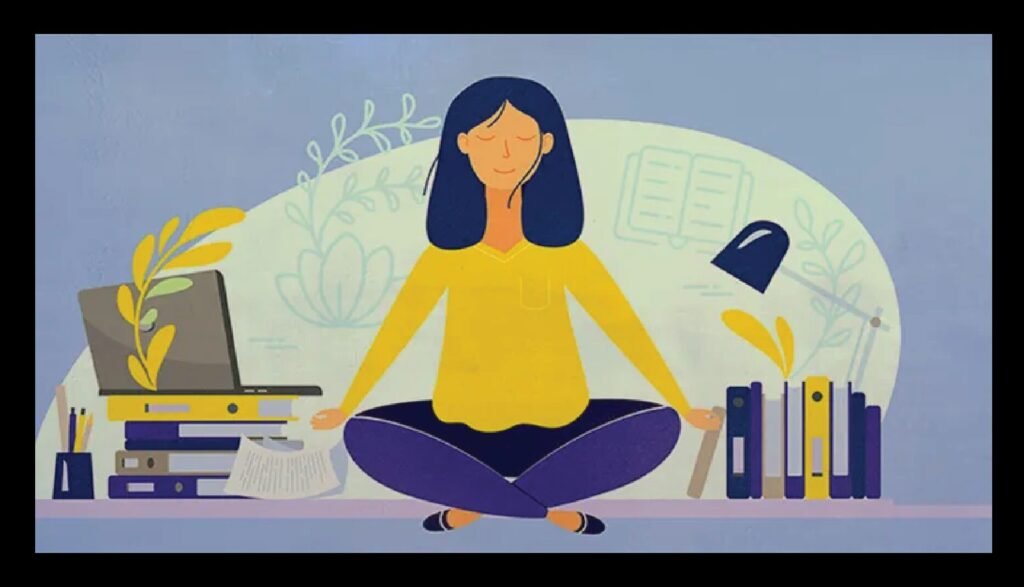
- Mindfulness lowers cortisol, the stress hormone.
- Ten minutes of deep breathing before studying can improve focus.
- Guided meditation apps like Headspace and Calm are effective.
- Use affirmations such as, “I am calm, I am prepared, I will do my best.”
- Stay Physically Active
- Exercise increases blood flow to the brain.
- Quick workouts, yoga, or stretching can help.
- Brisk walking is also effective.
- Just 20 minutes of activity daily can significantly reduce stress.
- Eat Brain-Boosting Foods
- Include omega-3-rich foods like salmon, walnuts, and chia seeds.
- Choose dark chocolate in moderation.
- Incorporate fruits like blueberries, bananas, and oranges.
- Opt for whole grains for steady energy.
- Avoid excessive caffeine, junk food, and sugary snacks.
- Stay Hydrated
- Dehydration leads to fatigue and brain fog.
- Keep a water bottle near your study area.
- Drink 8 to 10 glasses of water daily.
- Use Effective Study Techniques
- Practice active recall; test yourself instead of just re-reading.
- Utilize mind maps and flashcards for quick revisions.
- Teaching someone else can also boost your retention.
- Use Music to Relax & Concentrate
- Classical or instrumental music can improve focus.
- Lo-fi or nature sounds help calm the mind.
- Steer clear of loud, distracting lyrics while studying.
- Avoid Procrastination
- Start with easy topics to build momentum.
- Use time-blocking to structure your study hours.
- Reward yourself after completing tasks.
- Talk It Out & Seek Support
- Share your concerns with friends or family.
- Join study groups for motivation.
- Seek help from mentors when you feel stuck.
- Use Positive Visualization

- Close your eyes and imagine yourself writing your exams calmly and successfully.
- This practice can reduce nervousness and build confidence.
- Reduce Distractions
- Turn off notifications from your devices.
- Use website blockers to limit access to social media.
- Create a study space that is free from distractions.
- Practice Mock Tests with Timers
- Simulate the exam environment.
- This helps improve time management.
- It builds confidence in the exam hall.
- It can also help identify areas that need improvement.
Psychological Tricks to Beat Exam Anxiety
- Replace “What if I fail?” with “What if I succeed?”
- Break daunting tasks into smaller goals.
- Keep a gratitude list to maintain a positive outlook.
- Smile more; it tricks your brain into feeling calm.
Quick Calming Exercises Before Entering the Exam Hall
- Practice 4-7-8 breathing—inhale for 4 seconds, hold for 7 seconds, and exhale for 8 seconds.
- Try progressive muscle relaxation by tensing and relaxing each muscle group.
- Do a mini meditation: close your eyes, take five deep breaths, and focus only on your breathing.
- Use the power pose—stand tall with your hands on your hips to boost confidence.
FAQs
Q1. How can I stay calm 1 hour before an exam?
Practice deep breathing, review key points, and avoid cramming at the last minute.
Q2. What foods help with exam stress?
Blueberries, bananas, walnuts, dark chocolate, and whole grains.
Q3. How can I focus when I feel anxious before exams?
Use mindfulness techniques, take mock tests, and take short breaks to keep your mind calm.
Q4. How much sleep should I get before exams?
Aim for at least 7 hours to keep your memory and focus sharp.
Conclusion
Exams are challenging, but you are tougher. By practicing calmness, building focus, and using these techniques daily, you can enter the exam room with confidence and clarity.
Remember, exams evaluate your preparation, not your worth. Stay calm, stay focused, and success will follow.
📊 Stress Triggers vs. Solutions (Pre-Exam Cheat Sheet)
Use this quick guide an evening before your exam or on exam day morning.
| 🚨 Stress Trigger | ✅ Best Solution | ⚡ Quick Action (2–10 min) | ⏱️ Time Cost | 🎯 Expected Benefit |
|---|---|---|---|---|
| Last-minute overwhelm | Focus on high-yield topics and active recall | Create a 5-item “must-remember” list; quiz yourself once | 8–10 min | Sharper recall; reduced panic |
| Racing thoughts / anxiety | Breathing + grounding (4-7-8, name 5 senses) | Do 3 cycles of 4-7-8; then “5 things you see/hear/feel” | 3–5 min | Lower heart rate; calmer focus |
| Phone/social distractions | Environment control + app limits | Airplane mode; place phone in another room; set 45-min timer | 2 min | Deep work window without interruptions |
| Mental fatigue | Micro-break + movement snack | Stand, stretch neck/hips, 20 bodyweight squats or brisk walk | 3–6 min | Renewed energy and attention |
| Blanking on key formulas | Retrieval practice on a one-page sheet | Write top 10 formulas/concepts from memory; check & correct | 7–9 min | Faster recall under pressure |
| Negative self-talk | Reframe with evidence-based affirmations | Read: “I’ve studied X hours; I’ve passed practice sets; I can do this.” | 2–3 min | Confidence boost; lower stress |
| Time-management fear | Timed practice + section pacing plan | Skim past paper; assign minutes per section; mark triage items | 8–10 min | Predictable pacing in exam hall |
| Sleep debt | Wind-down routine + caffeine cutoff | Dim lights, hot shower, 10-min read; no screens/caffeine | 10 min (then sleep) | Better memory consolidation |
| Low hydration / brain fog | Water first, then light snack | Drink a glass of water; eat banana/nuts; prep exam-day bottle | 2–4 min | Improved concentration and stamina |
| Perfectionism loop | “Good-enough pass” pass: 80/20 review | Skim summaries, not details; accept “complete & move on” | 6–8 min | Higher coverage; less anxiety |
for more article like this click here


Leave a Reply