
Introduction
Planning is essential for success in both personal and professional life. Whether you’re managing a business project, preparing for exams, or organizing your daily schedule, good planning helps you save time, reduce stress, and achieve better results.
However, many people fail at planning due to avoidable mistakes. This guide will explore the 10 most common planning mistakes and offer practical strategies to avoid them, enabling you to plan smarter and succeed faster.
Why Planning is Crucial for Success

Without planning, goals remain vague dreams. Planning helps:
- Provide clarity of direction.
- Optimize time and resources.
- Anticipate challenges in advance.
- Reduce stress and overwhelm.
- Build confidence and consistency.
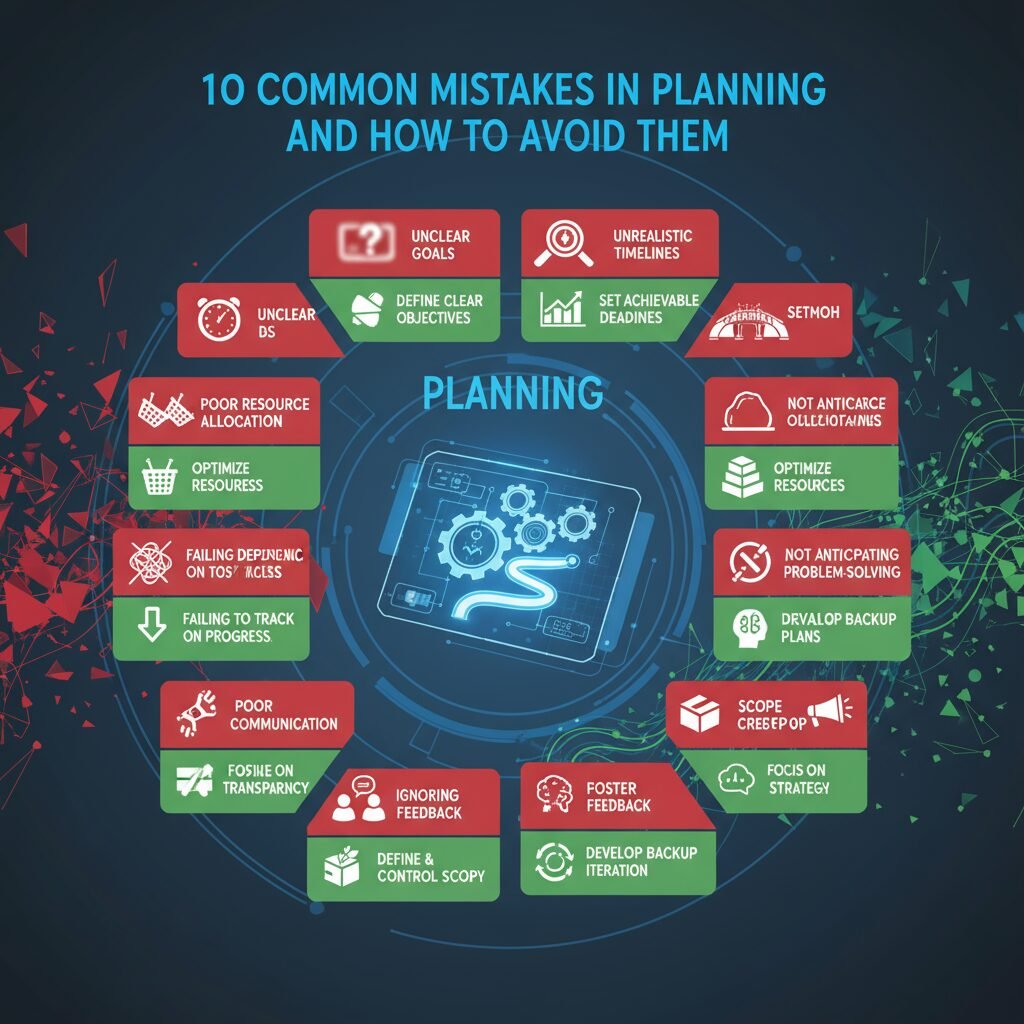
Now, let’s break down the most common mistakes in planning and how to avoid them.
| Aspect of Planning | Common Mistakes | How to Avoid |
|---|---|---|
| Goal Setting | Unclear or unrealistic goals | Use SMART goals (Specific, Measurable, Achievable, Relevant, Time-bound) |
| Time Management | Poor scheduling or overcommitting | Apply time blocking and prioritize high-impact tasks |
| Resource Allocation | Ignoring budget or manpower limitations | Plan resources realistically with backups in place |
| Flexibility | Rigid plans with no room for change | Include buffer time and adaptable strategies |
| Execution | Procrastination or lack of follow-through | Break tasks into smaller steps and track progress |
Mistake 1: Lack of Clear Goals
The Problem:
Many people start planning without a clear vision of what they want to achieve. This leads to confusion, wasted effort, and unfinished tasks.
How to Avoid It:
- Define SMART goals (Specific, Measurable, Achievable, Relevant, Time-bound).
- Write down why the goal matters to you.
- Break big goals into smaller milestones.
Mistake 2: Ignoring Time Management
The Problem:
Failing to allocate time properly results in missed deadlines and stress.
How to Avoid It:
- Use time blocking to schedule tasks.
- Follow the 80/20 Rule (Pareto Principle), focusing on the tasks that yield the biggest results.
- Avoid multitasking; work on one task at a time.
Mistake 3: Overcomplicating the Plan
The Problem:
Some people create overly complex plans that are difficult to follow, causing overwhelm.
How to Avoid It:
- Keep your plan simple and actionable.
- Use checklists or step-by-step task breakdowns.
- Review your plan weekly to ensure it’s realistic.
Mistake 4: Not Anticipating Obstacles

The Problem:
A plan that does not consider possible obstacles is incomplete.
How to Avoid It:
- Conduct a risk assessment.
- Have a backup plan ready for emergencies.
- Stay adaptable when things don’t go as expected.
Mistake 5: Failure to Prioritize Tasks
The Problem:
Without prioritization, small tasks consume time while important tasks get overlooked.
How to Avoid It:
- Use the Eisenhower Matrix to distinguish between urgent and important tasks.
- Focus on high-value activities first.
- Avoid perfectionism with low-priority tasks.
Mistake 6: Neglecting Flexibility
The Problem:
Rigid planning leaves no room for adjustments, leading to frustration.
How to Avoid It:
- Allow buffer time in your schedule.
- Treat your plan as a living document that evolves.
- Be open to feedback and new opportunities.
Mistake 7: Poor Communication
The Problem:
In team projects, unclear communication creates delays and confusion.
How to Avoid It:
- Clearly define roles and responsibilities.
- Use project management tools like Trello, Asana, or Slack.
- Hold regular check-ins to ensure everyone is on the same page.
Mistake 8: Depending Too Much on Tools

The Problem:
Relying solely on apps and tools without self-discipline can backfire.
How to Avoid It:
- Use tools as support, not crutches.
- Build strong personal habits.
- Focus on execution, not just planning.
Mistake 9: Failing to Track Progress
The Problem:
Without monitoring, you don’t know if your plan is effective.
How to Avoid It:
- Use weekly progress reviews.
- Track measurable results like hours worked and goals achieved.
- Adjust your plan based on progress.
Mistake 10: Not Reviewing & Improving
The Problem:
Some people never revisit their plans, so they repeat the same mistakes.
How to Avoid It:
- Schedule monthly reflections.
- Ask yourself: What worked? What didn’t?
- Continuously improve your strategy.
📊 Common Mistakes in Planning & How to Avoid Them
⚠️ Common Mistakes
- Unclear or unrealistic goals
- Poor scheduling or overcommitting
- Ignoring budget or manpower limits
- Rigid plans with no flexibility
- Procrastination & weak execution
✅ How to Avoid
- Set SMART goals 🎯
- Use time blocking ⏳
- Plan resources realistically 📊
- Keep strategies adaptable 🔄
- Break tasks into smaller steps 📝
Benefits of Avoiding Planning Mistakes
When you avoid these mistakes, you gain:
- Higher productivity.
- Reduced stress and better focus.
- Faster achievement of goals.
- Greater adaptability to challenges.
- Confidence in your path forward.
Voice Search Optimized FAQs
- Q1: What are the most common mistakes in planning?
The most common mistakes in planning include lack of clear goals, poor time management, ignoring obstacles, and not tracking progress. - Q2: How can I avoid mistakes in planning?
You can avoid planning mistakes by setting SMART goals, prioritizing tasks, staying flexible, and reviewing your progress regularly. - Q3: Why is preparation important for success?
preparation is important because it helps you save time, reduce stress, and achieve goals more effectively.
Conclusion
Planning is the foundation of success, but only when done the right way. By avoiding these 10 common mistakes in preparation, you’ll set yourself up for greater productivity, lower stress, and long-term success in both personal and professional life.
Remember,preparation is not about perfection; it’s about progress and adaptability.Introduction
for more article click here


Leave a Reply