
Introduction
Have you ever set a goal, felt excited at first, but then lost focus or gave up? You’re not alone. Research shows that many people abandon their goals within weeks because they lack structure, clarity, and accountability. This is where SMART goals come in.
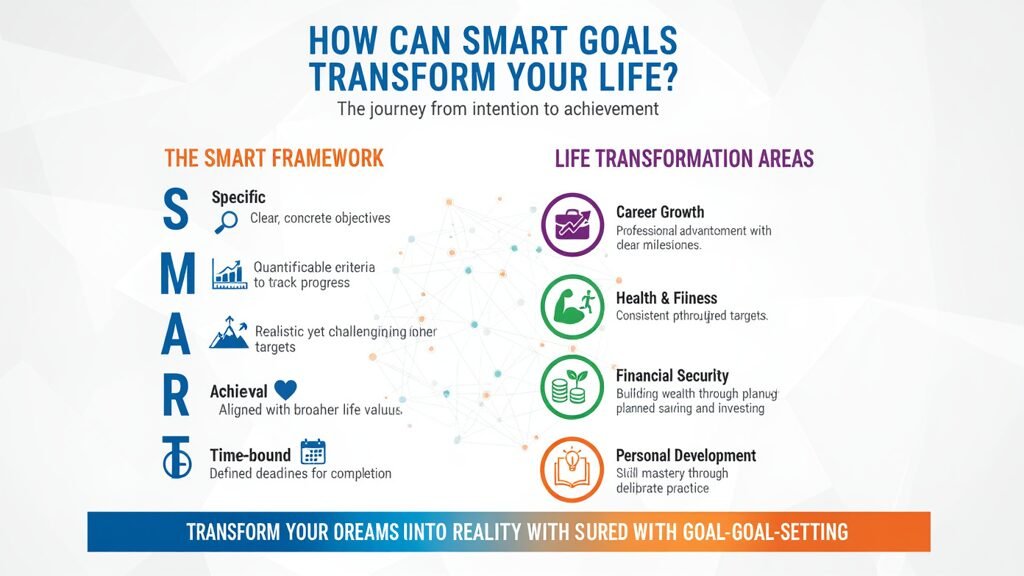
SMART goals provide a solid framework for turning vague dreams into clear, actionable steps. Whether you want to advance your career, improve your health, grow your finances, or build better habits, SMART goals offer a reliable system to help you stay on track and motivated.
In this article, we’ll delve into what SMART goals are, why they are effective, and how they can change your life in ways you never thought possible.
What Are SMART Goals?
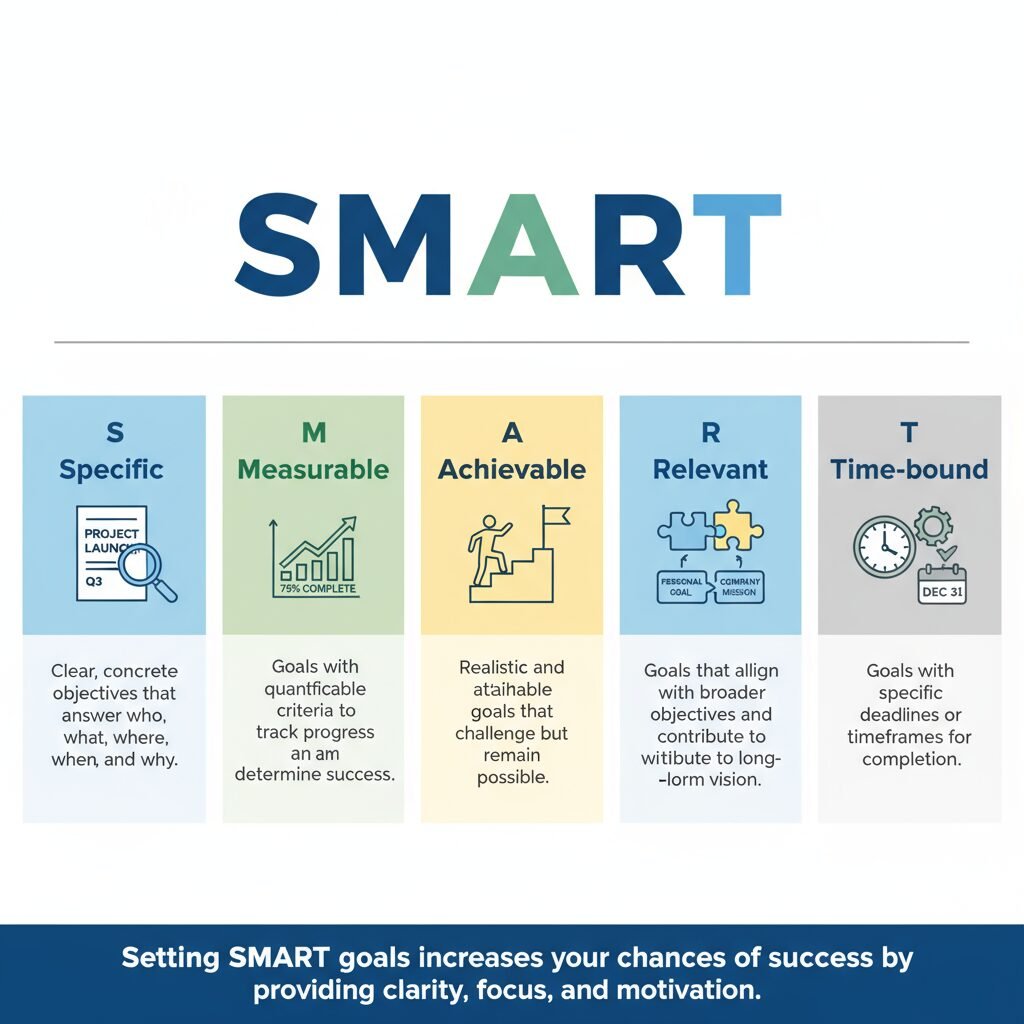
SMART is an acronym that stands for:
S – Specific: Clear and well-defined
M – Measurable: Trackable with progress indicators
A – Achievable: Realistic and attainable
R – Relevant: Connected to your values and life purpose
T – Time-bound: Has a clear deadline
Instead of saying “I want to be healthier,” a SMART goal would be:
“I will walk 8,000 steps daily for the next 90 days to improve my fitness and energy.”
This small change in approach can make a big difference.
Why Do SMART Goals Work So Well?
The Psychology of Goal Setting
People are naturally motivated by clarity and progress. When you see measurable improvement, your brain releases dopamine, which encourages you to keep going. SMART goals leverage this psychology by providing structure for your ambitions.
Benefits of Using SMART Goals
- Clarity: You always know what you’re working toward.
- Motivation: Clear milestones keep you energized.
- Accountability: Tracking your progress prevents procrastination.
- Confidence: Small wins build long-term self-belief.
- Direction: Your daily actions align with your larger purpose.
The SMART Goals Framework Explained
- Specific – Clarity is Power
A vague goal: “I want to save money.”
A SMART goal: “I will save ₹5,000 per month for the next 12 months to build an emergency fund of ₹60,000.”
Being specific eliminates confusion. - Measurable – Track Your Progress
What gets measured gets improved. For example:
Instead of “I want to lose weight,” say:
“I will lose 2 kg per month for the next 6 months.”
This way, you can track your progress at every step. - Achievable – Stay Realistic
Ambition is important, but unrealistic goals can cause frustration.
For example:
Unrealistic: “I will become a millionaire in 6 months.”
Achievable: “I will increase my income by 20% in one year through side projects.”
Achievable goals build confidence and consistency. - Relevant – Align With Your Purpose
Your goals should match your values and priorities.
Example: If your long-term dream is to become a writer, a relevant SMART goal might be:
“I will write 500 words every day for 6 months to complete my first draft.” - Time-bound – Create Urgency
Deadlines keep you accountable.
Instead of: “I will learn a new skill someday,”
say: “I will complete an online digital marketing course in 8 weeks.”
Without time limits, goals often remain unfinished.
SMART Goals Framework Cheat Sheet
A quick reference table explaining the meaning of each SMART goal element with examples.
| Letter | Meaning | Explanation | Example |
|---|---|---|---|
| S | Specific | Be clear and detailed about what you want to achieve. | “Walk 8,000 steps daily to improve fitness.” |
| M | Measurable | Set metrics or numbers to track your progress. | “Lose 2 kg every month for 6 months.” |
| A | Achievable | Make sure your goal is realistic and within reach. | “Increase income by 20% in one year.” |
| R | Relevant | Align your goal with your bigger life priorities. | “Write 500 words daily to complete a book draft.” |
| T | Time-bound | Set a clear deadline to create urgency. | “Complete a digital marketing course in 8 weeks.” |
How SMART Goals Transform Your Life
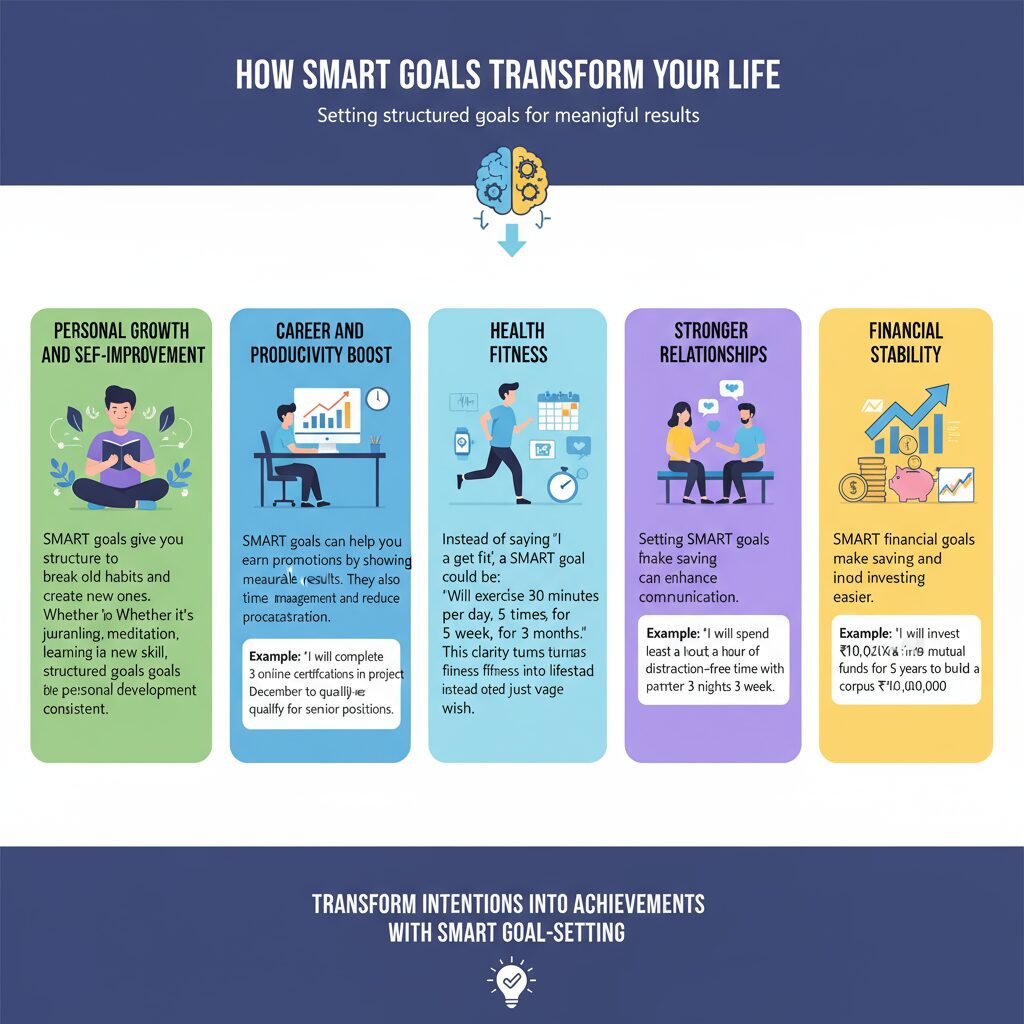
- Personal Growth and Self-Improvement
SMART goals give you the structure to break old habits and create new ones. Whether it’s journaling, meditation, or learning a new skill, structured goals make personal development consistent. - Career and Productivity Boost
SMART goals can help you earn promotions by showing measurable results. They also improve time management and reduce procrastination.
Example: “I will complete 3 online certifications in project management by December to qualify for senior positions.” - Health and Fitness
Instead of saying “I want to get fit,” a SMART goal could be:
“I will exercise 30 minutes a day, 5 times a week, for 3 months.”
This clarity turns fitness into a lifestyle instead of just a vague wish. - Stronger Relationships
Setting SMART goals in relationships can enhance communication. Example:
“I will spend at least 1 hour of distraction-free time with my partner 3 nights a week.” - Financial Stability
SMART financial goals make saving and investing easier. Example:
“I will invest ₹10,000 per month into mutual funds for 5 years to build a corpus of ₹6,00,000.”
Practical Examples of SMART Goals
- Health: “I will drink 3 liters of water daily for the next 60 days.”
- Career: “I will update my resume and apply to 10 jobs per week for the next 2 months.”
- Learning: “I will complete one book on leadership every month for 12 months.”
- Finance: “I will pay off ₹20,000 debt in 10 months by paying ₹2,000 monthly.”
Common Mistakes in Goal Setting

- Setting goals that are too vague
- Creating goals without a deadline
- Overloading yourself with too many goals
- Ignoring progress tracking
- Not aligning goals with personal values
How to Stay Motivated and Track Progress
- Use Journals or Apps – Track daily progress.
- Celebrate Small Wins – Reward yourself for milestones.
- Accountability Partners – Share goals with a friend or coach.
- Adjust if Needed – Goals can be flexible when life changes.
Conclusion: Transform Your Life With SMART Goals
SMART goals are more than just a productivity tool – they’re a lifestyle shift. By making your goals specific, measurable, achievable, relevant, and time-bound, you create a roadmap for success in every area of life.
Remember: transformation doesn’t happen overnight. But with SMART goals, every small step compounds into massive long-term growth.Conclusion: Transform Your Life With SMART Goals
SMART goals are more than just a productivity tool – they’re a lifestyle shift. By making your goals specific, measurable, achievable, relevant, and time-bound, you create a roadmap for success in every area of life.
Remember: transformation doesn’t happen overnight. But with SMART goals, every small step compounds into massive long-term growth.
FAQs
Q1: What is the main benefit of SMART goals?
SMART goals give you clarity, focus, and accountability, making it easier to achieve results.
Q2: How do SMART goals improve personal growth?
They help you build consistent habits, track progress, and stay motivated.
Q3: Can SMART goals be used for career success?
Yes, SMART goals make career growth measurable and achievable, such as completing certifications or hitting performance targets.
Q4: How are SMART goals different from regular goals?
Unlike vague goals, SMART goals are structured with deadlines and measurable outcomes.
Q5: What’s an example of a SMART goal in daily life?
“I will read 20 pages of a book daily for the next 30 days.”
for more article like this click here


Leave a Reply